
Circular Economy & Sustainability
Circular Economy in Urban India: A New Governance Model
Monday, January 09, 2026
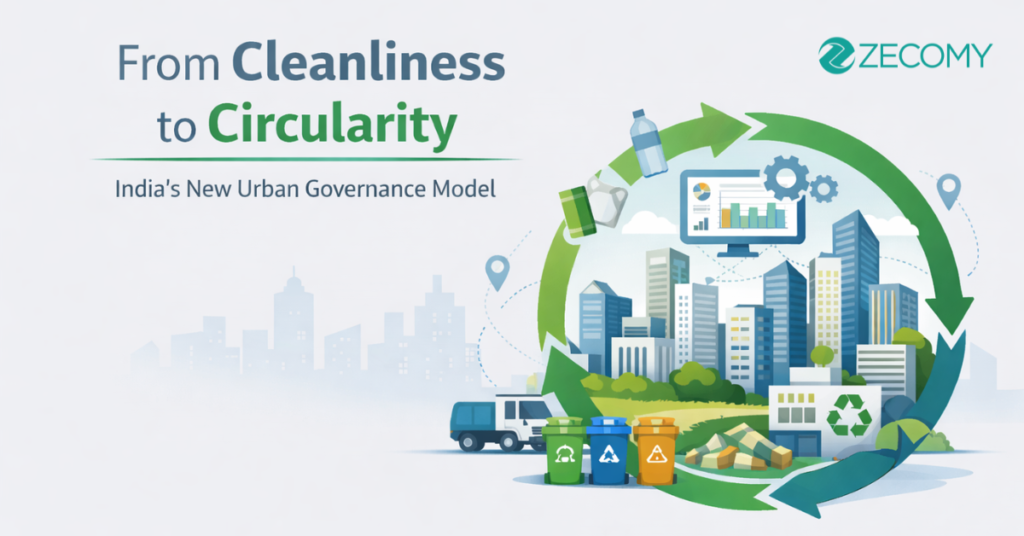
Swachh Survekshan is no longer just a cleanliness ranking. It has evolved into one of the world’s most scalable platforms for circular economy governance, influencing how Indian cities plan, measure, and manage material flows.
With the launch of SBM-Urban 2.0 and the notification of the Solid Waste Management (SWM) Rules, 2026 (effective April 1, 2026), India is decisively moving beyond the idea of “cleaning up” cities. The focus is now on structural resource management, where waste is treated as a recoverable asset rather than a disposal problem.
This transition marks a fundamental shift in the DNA of Indian urban governance.
India’s Shift from Waste Management to Resource Management
For years, urban waste management in India was evaluated primarily on visible cleanliness—collection efficiency, sweeping frequency, and landfill operations. That model is rapidly becoming obsolete.
The current policy direction emphasizes:
Waste reduction at source
Maximum recovery of materials
Scientific processing across all waste streams
Minimal reliance on landfilling
In essence, cities are being redesigned to function as resource recovery systems, not waste sinks.
The New Governance Triangle Reshaping Indian Cities
India’s urban circular economy transition rests on a powerful three-pillar governance framework that aligns vision, regulation, and outcomes.
1. SBM-Urban 2.0: Defining the Vision
SBM-Urban 2.0 sets the strategic direction for garbage-free cities. Its focus extends beyond sanitation to systemic transformation, including:
100% segregation of waste at source
Universal access to scientific waste processing
Remediation and closure of legacy dumpsites
Improved working conditions and dignity for sanitation workers
This vision establishes cleanliness as a baseline, not the end goal.
2. SWM Rules, 2026: Defining the Rules
The Solid Waste Management Rules, 2026 form the regulatory backbone of India’s circular economy transition. They introduce enforceable obligations across the waste value chain, particularly for bulk waste generators and urban local bodies.
Key regulatory shifts include:
Mandatory source segregation into wet, dry, sanitary, and special-category waste
Material recovery and recycling targets for bulk waste generators
Traceability requirements for plastic waste and construction & demolition waste
Scientific processing mandates for all waste streams
Strict limits on landfilling, restricted only to inert residues
Strengthened digital compliance, real-time monitoring, and accountability mechanisms
The rules also prescribe clear timelines for legacy waste remediation, moving India away from open dumping as an acceptable urban practice.
3. Swachh Survekshan: Measuring Outcomes
Swachh Survekshan operationalizes policy by converting intent into measurable performance.
Its evolution is particularly significant:
Use of geotagged and time-stamped evidence
Third-party verification and audits
Performance-linked incentives for cities
Integration of citizen participation metrics
By tying rankings and recognition to verified outcomes, Swachh Survekshan ensures that compliance is data-driven, transparent, and accountable.
Why This Shift Matters Now
The convergence of SBM-Urban 2.0, SWM Rules 2026, and Swachh Survekshan creates a closed governance loop:
Vision defines what cities must become
Rules define what cities must do
Measurement defines how cities are evaluated
For waste generators, urban bodies, and service providers, this means:
Responsibility is no longer optional
Compliance is continuous, not periodic
Digital reporting and traceability are non-negotiable
Urban governance is moving from intent-based compliance to evidence-based accountability.
The Philosophical Shift: From Disposal to Elimination
The most profound change is not regulatory—it is philosophical.
Cities are no longer rewarded for how efficiently they dispose of waste, but for how effectively they eliminate waste through reduction, reuse, recycling, and recovery.
This is the core principle of the circular economy:
Waste is not managed—it is designed out
Materials are kept in circulation for as long as possible
Landfills become a last resort, not a default solution
India is now applying this philosophy at an unprecedented urban scale.
Circular Cities Need Circular Citizenship
A circular city cannot exist without circular behavior.
Segregation at source, responsible consumption, and participation in decentralized processing systems are as critical as policy and infrastructure. Swachh Survekshan reinforces this by embedding citizen participation into city performance metrics.
Together, SBM-Urban 2.0, the SWM Rules 2026, and Swachh Survekshan are not just reshaping cities—they are shaping circular citizenship.
Building India’s Circular Urban Future
India’s urban transformation is no longer about cleaner streets alone. It is about:
Redesigning material flows
Embedding accountability into governance
Aligning policy, technology, and citizen action
From cleanliness to circularity, India is steadily building a model of sustainable urbanisation that is systematic, measurable, and scalable.
Frequently Asked Questions (FAQs)
1. What does "circular economy in urban India" mean?
The circular economy in urban India refers to a system where cities minimize waste generation and maximize resource recovery through segregation, recycling, reuse, and scientific processing, reducing dependence on landfills.
2. How is Swachh Survekshan linked to the circular economy?
Swachh Survekshan evaluates cities on source segregation, waste processing, citizen participation, and digital reporting. By rewarding verified outcomes rather than intentions, it drives cities toward circular economy practices.
3. What is new in the Solid Waste Management Rules, 2026?
The SWM Rules, 2026 introduce mandatory segregation, recycling and recovery targets for bulk waste generators, traceability for plastic and C&D waste, digital compliance, and strict timelines for legacy waste remediation.
4. When do the SWM Rules, 2026 come into effect?
The Solid Waste Management Rules, 2026 come into force on 1 April 2026, replacing the SWM Rules, 2016 while preserving obligations already undertaken.
5. Who must comply with the SWM Rules, 2026?
Urban local bodies, bulk waste generators, commercial establishments, institutions, industries, and waste processors are all required to comply with the SWM Rules, 2026.
6. What role does SBM-Urban 2.0 play in urban waste governance?
SBM-Urban 2.0 provides the national vision for garbage-free cities by promoting 100% source segregation, scientific processing of waste, remediation of legacy dumpsites, and dignity for sanitation workers.
7. Why is landfilling being restricted under the new framework?
Landfilling is limited to inert residues to prevent environmental damage and encourage recycling, recovery, and waste-to-energy solutions aligned with circular economy principles.
8. How does digital compliance improve accountability?
Digital compliance enables real-time monitoring, traceability, and performance measurement, ensuring transparency and reducing manual reporting gaps in urban waste management systems.
9. What is meant by “circular citizenship”?
Circular citizenship refers to active participation by citizens in waste segregation, responsible consumption, and compliance with local waste management systems, enabling cities to function as circular ecosystems.
10. How do these reforms impact businesses and bulk waste generators?
Businesses must implement segregation, meet recycling targets, maintain digital records, and ensure traceability of waste streams to remain compliant under the SWM Rules, 2026.
11. How does Swachh Survekshan enforce accountability?
Swachh Survekshan uses geotagged evidence, third-party verification, and performance-linked incentives to ensure that compliance is measurable, verifiable, and outcome-driven.
12. Why is India’s approach to circular cities globally significant?
India is implementing circular economy governance across thousands of cities simultaneously, making it one of the largest and most scalable urban sustainability transformations in the world.