
Circular Economy & Sustainability
Waste Management Compliance in India: Cost of Compliance vs Cost of Non-Compliance
Tuesday, February 17, 2026
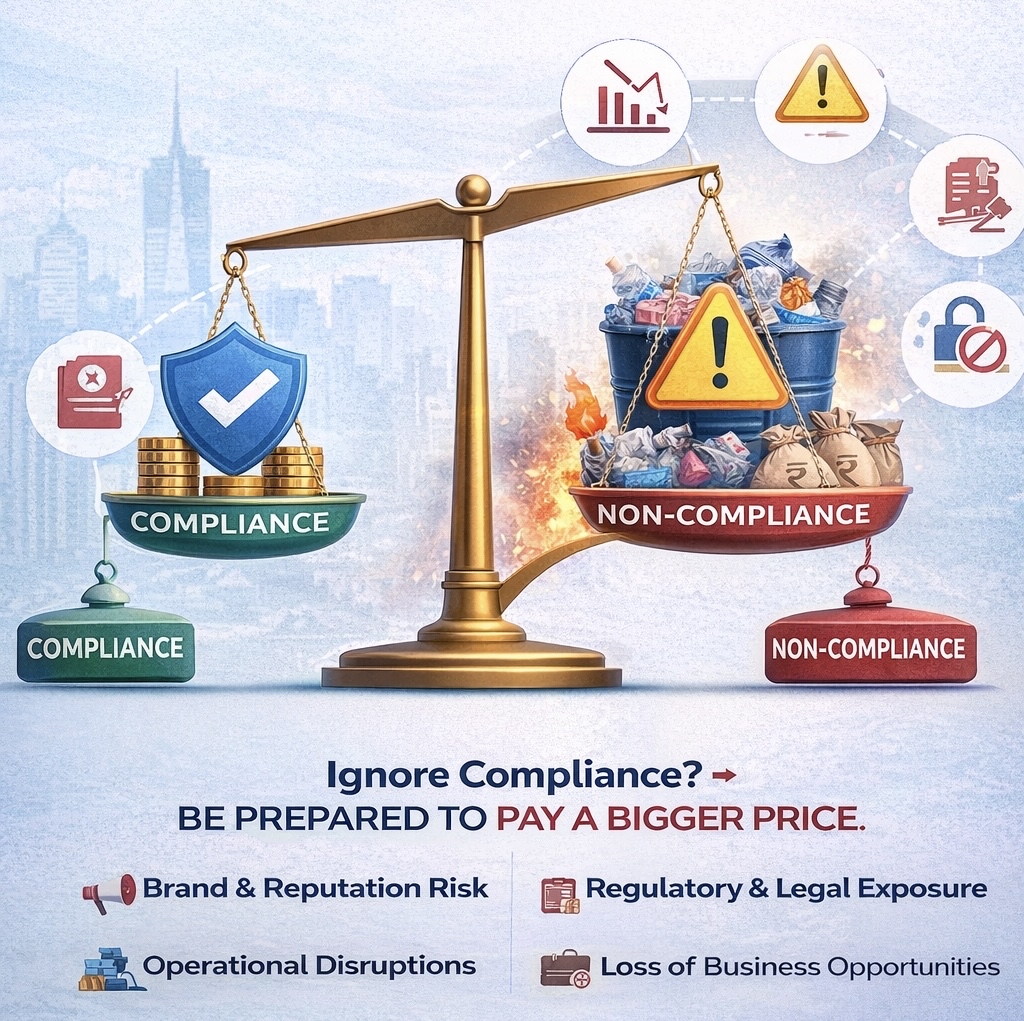
Waste Management Compliance in India is no longer a back-office function. As industrial expansion accelerates and regulatory oversight strengthens, Indian corporates are facing a new reality: the cost of compliance is measurable—but the cost of non-compliance can be existential.
Manufacturing is scaling. Corporates compliance is measurable—but the cost of non-compliance can be existential.
Alongside this growth comes an unavoidable outcome: the generation of large volumes of diverse waste streams — metal scrap, plastics, municipal waste, hazardous waste, e-waste, batteries, and packaging materials.
Indian corporates are not just producers of goods and services. They are significant generators of waste. And with that comes legal and operational accountability.
The critical question is:
Is this waste being managed in a compliant, traceable, and defensible manner?
Waste Management Compliance in India: The Cost-Driven Mindset
In many organisations, waste management still operates in the background. It is treated as a logistical function rather than a governance priority.
This often results in decisions driven primarily by cost optimisation:
Maximising scrap recovery value
Selecting vendors offering higher rates
Reducing procedural friction
Prioritising operational convenience
While these choices may improve short-term financial metrics, they can weaken compliance integrity.
In today’s regulatory environment, Waste Management Compliance in India is not about price efficiency alone. It is about defensibility, verification, and lifecycle accountability.
The ‘Better Price’ Trap in Waste Management Compliance
Across industries, waste is frequently routed to vendors offering better commercial terms.
On the surface, this appears rational:
Higher scrap prices
Faster pickups
Fewer documentation requirements
However, the critical risk lies beyond the point of handover.
When waste is transferred without rigorous verification of:
Authorisations
Scope alignment
Downstream processors
Processing capacity
Regulatory validity
The liability does not transfer.
Under Waste Management Compliance in India, responsibility continues to rest with the generator. If the waste is eventually handled by an unauthorised or non-compliant entity, the regulatory exposure traces back to the originating organisation.
The short-term gain can create long-term vulnerability.
Regulatory Accountability Under Waste Management Compliance in India
India’s regulatory framework has evolved significantly under the Environment (Protection) Act and associated waste management rules.
Traceability expectations now extend across the full lifecycle of waste:
Generation
Collection
Transportation
Processing
Final disposal or recovery
During audits or inspections, organisations are expected to demonstrate:
Where the waste went
Who processed it
Whether the processor was authorised
Whether the category matched the authorisation scope
Whether volumes were within permitted capacity
Inability to establish this chain of custody can lead to:
Legal notices
Financial penalties
Environmental compensation
Operational restrictions
Enforcement is no longer sporadic. It is increasingly structured and data-driven.
This is why Waste Management Compliance in India demands system strength—not reactive documentation.
Brand, ESG and Waste Management Compliance Risk
Beyond regulatory implications lies reputational exposure.
Compliance failures today do not remain internal matters. They surface in:
ESG disclosures
Sustainability reporting
Investor due diligence
Global client audits
Supply chain assessments
For organisations operating in regulated ecosystems or servicing multinational clients, a single lapse can impact credibility.
In this context, Waste Management Compliance in India directly influences trust capital.
Reputation, once compromised, is significantly more expensive to rebuild than compliance systems are to establish.
Operational Disruptions from Weak Waste Management Compliance
Compliance gaps rarely surface at convenient times.
They emerge during:
Internal audits
External inspections
Stakeholder reviews
Enterprise onboarding processes
When weaknesses are discovered, organisations must:
Replace vendors
Reconstruct documentation
Conduct emergency verifications
Divert management bandwidth
What appeared to be a cost-saving decision begins affecting efficiency, productivity, and internal resources.
Effective Waste Management Compliance in India prevents reactive disruption.
The Silent Impact: Loss of Future Business
Perhaps the most underestimated consequence of weak compliance is exclusion from opportunity.
Increasingly, structured waste compliance systems are prerequisites for:
Participation in global supply chains
Large enterprise contracts
Public sector engagements
Sustainability-linked procurement
Waste management practices are now part of formal due diligence frameworks.
Organisations unable to demonstrate transparent, verified systems risk being filtered out before commercial discussions even begin.
The cost of non-compliance, therefore, includes lost future revenue.
The Myth of “Cheaper” Non-Compliance
The assumption that non-compliance is financially advantageous does not withstand scrutiny.
The additional revenue realised from an unverified vendor may provide short-term benefit. However, when regulatory action, reputational damage, or operational disruption occurs, the cumulative impact far exceeds the initial gain.
When viewed holistically:
Financial risk increases
Legal exposure escalates
Brand equity weakens
Growth opportunities shrink
In reality, non-compliance is not cheaper. It is deferred cost with compounded risk.
Compliance in Appearance vs Compliance in Reality
A common challenge among corporates is the belief that they are already compliant.
Waste is being cleared. Vendors are engaged. Documentation exists.
However, Waste Management Compliance in India is no longer defined by activity. It is defined by assurance.
True compliance requires:
Independent verification of vendor authorisations
Alignment of waste categories with processing approvals
Downstream visibility
Capacity validation
Audit-ready documentation
End-to-end traceability
Without these controls, what exists may be compliance in appearance—not compliance in reality.
Why Waste Management Compliance in India Is a Strategic Imperative
Waste compliance today intersects with:
Governance
Risk management
ESG positioning
Operational continuity
Market access
It is not a cost centre. It is a governance benchmark.
Organisations that invest in structured, traceable, and verifiable systems do not merely avoid penalties. They build resilience, credibility, and competitive strength.
In India’s evolving regulatory landscape, Waste Management Compliance in India is not optional.
It is strategic infrastructure.
Conclusion
The debate between the cost of compliance and the cost of non-compliance is no longer theoretical.
Short-term financial optimisation cannot outweigh long-term regulatory, reputational, and operational risk.
The real differentiator for Indian corporates will not be who manages waste at the lowest cost — but who manages it with the highest level of transparency, verification, and accountability.
Because in the current environment, the cost of getting compliance wrong is significantly higher than the cost of getting it right.
Frequently Asked Questions (FAQs)
1. What is Waste Management Compliance in India?
Waste Management Compliance in India refers to adherence to environmental laws governing the generation, storage, transportation, processing, and disposal of waste. It requires organisations to ensure proper authorisations, maintain documentation, verify downstream processors, and establish traceability across the entire waste lifecycle.
2. Who is responsible for waste once it is handed over to a vendor?
Under Indian environmental regulations, responsibility does not end at handover. The waste generator remains accountable if the waste is processed by an unauthorised or non-compliant entity. This is why vendor verification and downstream traceability are critical components of Waste Management Compliance in India.
3. What are the risks of non-compliance in waste management?
Non-compliance can lead to:
Regulatory notices
Financial penalties
Environmental compensation
Operational restrictions
Reputational damage
Loss of business opportunities
In many cases, the long-term cost of non-compliance significantly exceeds the short-term financial gain from cost-driven decisions.
4. How can corporates verify vendor compliance?
Corporates should conduct structured due diligence, including:
Validating SPCB/CPCB authorisations
Checking waste category alignment
Reviewing permitted processing capacity
Verifying downstream processors
Maintaining audit-ready documentation
Independent verification strengthens Waste Management Compliance in India and reduces regulatory exposure.
5. Is documentation alone sufficient for waste compliance?
No. Documentation without validation creates only surface-level compliance. True Waste Management Compliance in India requires operational verification, traceability systems, and defensible audit trails that demonstrate where waste moved and how it was processed.
6. Why is waste management compliance important for ESG reporting?
Waste compliance directly impacts ESG disclosures, sustainability reporting, and investor assessments. Weak systems can affect credibility with global clients and institutional stakeholders. Strong Waste Management Compliance in India enhances governance ratings and supply chain eligibility.
7. How does waste compliance impact future business opportunities?
Many enterprise contracts and global supply chains now include environmental due diligence. Organisations unable to demonstrate structured Waste Management Compliance in India risk exclusion from high-value commercial opportunities.
8. What is the difference between compliance in appearance and compliance in reality?
Compliance in appearance refers to routine waste clearance and basic documentation.
Compliance in reality involves:
Verified vendor authorisations
End-to-end traceability
Capacity validation
Audit readiness
Independent assurance
The latter is what regulators and stakeholders increasingly expect.