
Corporate Playbook — Accelerating ESG and E-Waste Management
ESG and E-Waste Management are now core priorities for corporate sustainability teams. With increasing regulation, disclosure expectations, and material recovery opportunities, organizations must build structured programs that integrate compliance, circularity, and reporting.
Why this matters now:
Today, sustainability teams aren’t just fighting for compliance — they’re fighting to protect brand trust, investor confidence, and supply resilience. Every discarded device represents not only a waste management problem, but also a strategic opportunity to recover value, reduce emissions, and build responsible circular business models.
This is not just about e-waste.
It’s about building a corporate future where sustainability is not a reporting exercise — but a business advantage.
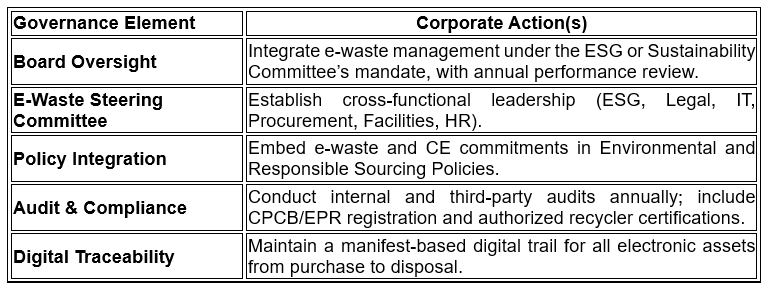
Governance & Accountability Framework
Key requirements for enterprises
Define oversight and traceability
Maintain an e-waste risk register
Conduct quarterly compliance reviews
Align with EPR and state regulatory norms
Regulatory & Reporting Landscape — India vs Global
| Region | Key Policies & Obligations |
|---|---|
| India | E-Waste Rules 2022, CPCB EPR portal, BRSR reporting |
| Global | EU WEEE, OECD EPR, ISSB, GRI, SASB |
Procurement & Circular Supply Chains
Procurement plays a central role in ESG and E-Waste Management:
Life-cycle-based sourcing
Supplier ESG scorecard
Recyclability and take-back clauses

Circular Economy Integration — 9R Framework
Organizations should embed the 9R Circularity Actions across procurement, operations, recovery, and reporting (Refuse → Recycle → Recover).
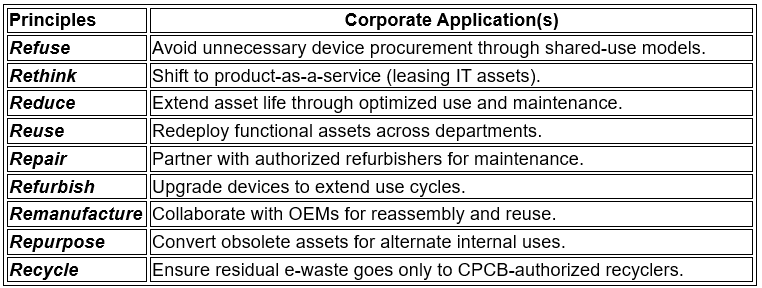
Each 9R action supports BRSR Principle 2 on responsible product lifecycle management and Principle 6 on environmental stewardship.
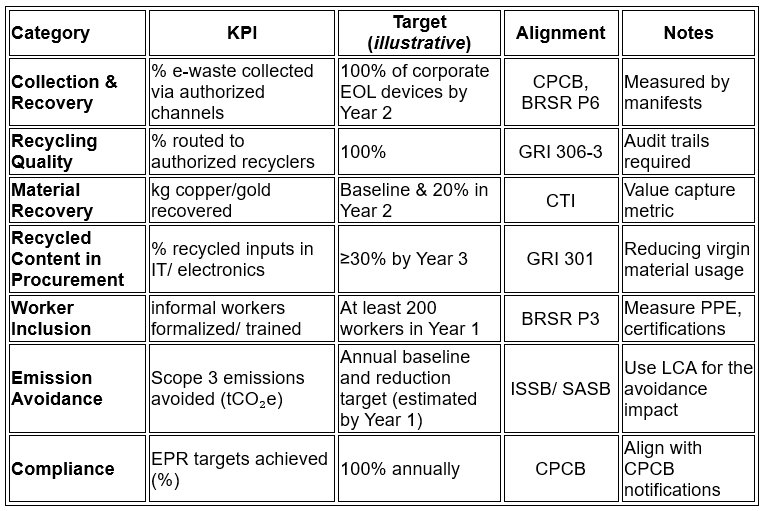
Sustainability Reporting & KPIs
Recommended ESG and E-Waste Management metrics include:
Material circularity indicator
Recovery efficiency
Scope 3 emissions avoided
% of devices recollected and refurbished

Corporate Roadmap — Step-by-Step Implementation
| Phase | Timeline | Outcome |
|---|---|---|
| Phase 0 | 0–2 months | Governance + baseline |
| Phase 1 | 2–6 months | Compliance + EPR alignment |
| Phase 2 | 6–12 months | Supply + recovery formalization |
| Phase 3 | 6–18 months | Reporting & verification |
| Phase 4 | 12–36 months | Circular product design |
Case Studies — Dell & HP Leadership
Insights from corporate sustainability leaders:
Closed-loop plastic chains (Dell)
Global take-back and refurbishment (HP)
Risk Management and Mitigation
Policy volatility
Informal-sector leakage
Greenwashing/ verification failures
Near-Term Targets for Companies
Q1: Baseline + EPR registration
Q2: 25% collection through pilots
Q3: 100% routing to authorized recyclers
Q4: Publish BRSR-aligned disclosures
Conclusion
Corporates that embed a structured ESG and E-Waste Management program unlock regulatory confidence, material recovery savings, Scope 3 reductions, and stronger investor trust.
To implement a customized and compliant E-Waste roadmap, connect with Zecomy — India’s trusted industrial e-waste management partner.
Book a consultation → contact us
Frequently Asked Questions (FAQs)
1. What is the connection between ESG and E-waste management?
E-waste management directly influences the Environmental and Governance dimensions of ESG by reducing toxic waste, improving material recovery, and ensuring regulatory compliance and responsible disposal.
2. Why should corporates prioritize e-waste management for ESG reporting?
Regulators and investors now expect transparent disclosure on waste handling, circularity, and recovery. Strong e-waste governance improves sustainability ratings, compliance scores, and investor trust.
3. Does e-waste management fall under Scope 3 emissions?
Yes. When electronics are disposed or recycled, the emissions associated with resource extraction, new product manufacturing, and transportation are considered Scope 3. Recovering materials helps reduce Scope 3 footprints.
4. What are the key policies for e-waste compliance in India?
The E-Waste (Management) Rules 2022 mandate producer and bulk-consumer responsibilities, EPR registration, documentation, collection targets, and authorized recycler engagement.
5. How does EPR support corporate circularity?
Extended Producer Responsibility (EPR) requires companies to ensure safe recycling and recovery of discarded electronics. This drives better product design, formal recovery channels, and reduced landfill dependency.
6. What KPIs should organizations track for ESG and E-waste management?
Common KPIs include % of e-waste collected formally, % of material recovered, circularity index, energy/emissions avoided, and authorized recycler traceability compliance.
7. Can informal recycling be part of a compliant ESG strategy?
Informal recyclers can be included only through formalization initiatives — safety training, PPE, certified dismantling hubs, and recycler partnerships. Unregulated informal processing violates compliance.
8. What role does procurement play in e-waste reduction?
Procurement teams can reduce e-waste by adopting life-cycle-based sourcing, requiring recyclability and take-back clauses, and evaluating suppliers using ESG scorecards.
9. What is the business ROI of e-waste recycling for companies?
Recovering metals like copper, aluminium, and gold reduces raw-material dependency and supports cost savings. Companies also benefit through better ESG scores, reduced risk exposure, and stronger stakeholder trust.
10. How can companies get started with e-waste management quickly?
The fastest path is to:
- Form an e-waste taskforce
- Register on the CPCB EPR portal
- Identify authorized recyclers
- Launch internal collection channels
- Track KPIs for BRSR/GRI reporting
Slide 1 Title
Slide 1 Sub Title
Slider 1 Description Text, Lorem ipsum dolor sit amet, consectetur adipiscing elit. Curabitur laoreet cursus volutpat. Aliquam sit amet ligula et justo tincidunt laoreet non vitae lorem.
Slide 2 Title
Slide 2 Sub Title
Slider 2 Description Text, Lorem ipsum dolor sit amet, consectetur adipiscing elit. Curabitur laoreet cursus volutpat. Aliquam sit amet ligula et justo tincidunt laoreet non vitae lorem.
Slide 3 Title
Slide 3 Sub Title
Slider 3 Description Text, Lorem ipsum dolor sit amet, consectetur adipiscing elit. Curabitur laoreet cursus volutpat. Aliquam sit amet ligula et justo tincidunt laoreet non vitae lorem.