
The Zecomy Knowledge Hub
EPR for Waste Tyres
Sixth Amendment Regulations & Compliance Guide
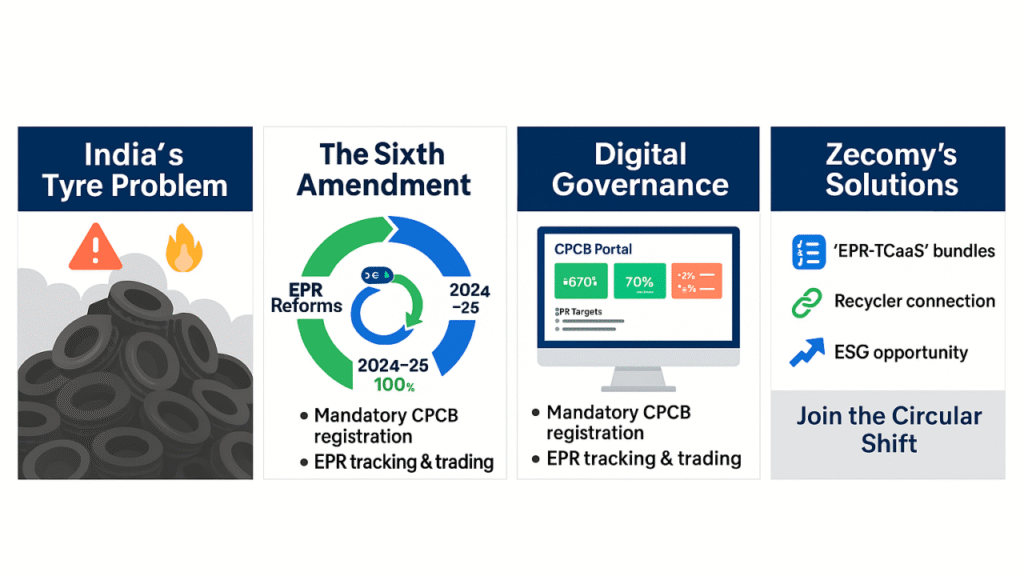
EPR for Waste Tyres — Sixth Amendment Regulations & Compliance Guide
India’s push toward stricter environmental accountability has intensified through the Sixth Amendment to the Hazardous and Other Waste Rules, 2016. The new regulation strengthens EPR for Waste Tyres by establishing clearer digital governance, verified recycling, and time-bound compliance responsibilities for producers, importers, recyclers, and retreaders.
What Is EPR for Waste Tyres?
EPR for Waste Tyres places accountability on tyre producers and associated stakeholders to ensure safe collection, recycling, retreading, and responsible disposal of end-of-life tyres — supported by mandatory digital reporting and traceability.
Key EPR Responsibilities
Collection and channelization
Recycling and material recovery
Retreading of usable tyres
Reporting and documentation
Responsible disposal
Key highlights of the Sixth Amendment for EPR for Waste Tyres
1. Clear Definitions for Better Compliance
The amendment clarifies roles like Producer, Recycler, Importer, and Retreader, and standardizes high-value outputs including:
Reclaimed rubber
Crumb rubber
Crumb Rubber Modified Bitumen (CRMB)
Recovered carbon black (rCB)
Pyrolysis oil
2. Mandatory CPCB Registration
Every entity linked to the tyre supply chain must now register on the CPCB digital portal to participate legally. The portal supports EPR certificate tracking, quarterly reporting, and compliance monitoring.
3. Time-Bound Recycling Targets
From 2025 onward, 100% recycling compliance becomes mandatory for eligible tyre quantities.
Related read: Understanding Plastic Waste Management Rules
4. Standardized Certification System
Registered recyclers issue digital EPR certificates based on standardized conversion factors and weightage for end-products — promoting high-value recycling like reclaimed rubber and rCB.
5. Restrictions on Tyre Imports
To curb unsafe pyrolysis practices, import of waste tyres for producing pyrolysis oil or char is now prohibited.
How Zecomy Supports EPR for Waste Tyres Compliance
1. EPR Tyre Compliance as a Service (EPR-TCaaS)
CPCB registration
EPR certificate management
Quarterly return filing
Compliance advisory
2. Tyre Circularity Solutions Pack
Verified recycler onboarding
Waste tyre channelization
Due-diligence and traceability reports
3. EPR Marketplace Assistance
Facilitated purchase of digital EPR certificates
Price monitoring for strategic buying
Speak to our compliance experts to simplify your EPR for Waste Tyres journey — get started now.
The Sixth Amendment marks a crucial evolution in India’s tyre waste management ecosystem. With digital traceability, strict documentation, and 100% recycling mandates, industries must act quickly. The transition may be challenging — but it also unlocks pathways for sustainability and circularity.
Zecomy empowers organizations with end-to-end EPR compliance, certified recycler networks, and ESG-ready traceability.
1. What is EPR for Waste Tyres in India?
2. What are the key changes in the Sixth Amendment for EPR on tyres?
3. Who must comply with EPR for Waste Tyres?
4. How do recycling targets work under the new rules?
5. What are the penalties for non-compliance with EPR for Waste Tyres?
6. How does digital governance support better compliance?
7. How can corporates simplify their tyre EPR compliance?
Slide 1 Title
Slide 1 Sub Title
Slider 1 Description Text, Lorem ipsum dolor sit amet, consectetur adipiscing elit. Curabitur laoreet cursus volutpat. Aliquam sit amet ligula et justo tincidunt laoreet non vitae lorem.
Slide 2 Title
Slide 2 Sub Title
Slider 2 Description Text, Lorem ipsum dolor sit amet, consectetur adipiscing elit. Curabitur laoreet cursus volutpat. Aliquam sit amet ligula et justo tincidunt laoreet non vitae lorem.
Slide 3 Title
Slide 3 Sub Title
Slider 3 Description Text, Lorem ipsum dolor sit amet, consectetur adipiscing elit. Curabitur laoreet cursus volutpat. Aliquam sit amet ligula et justo tincidunt laoreet non vitae lorem.